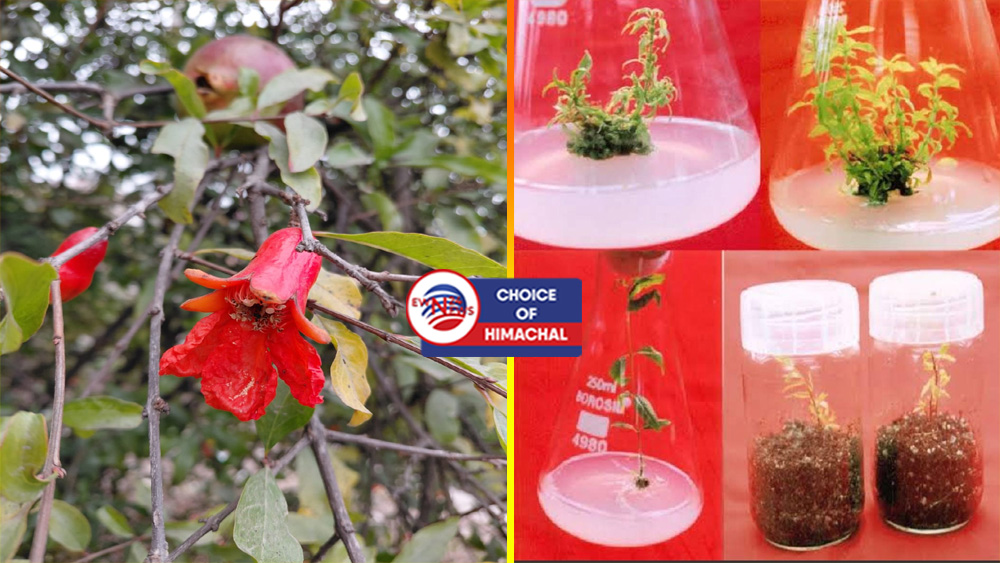
Introduction: The stage by highlighting why traditional farming is no longer sufficient for the modern pomegranate industry.
Resurgence of a "Superfood": Pomegranate is experiencing a global comeback due to its high nutraceutical value, specifically its richness in anthocyanins, polyphenols, and vitamins.
Economic Importance: It has transitioned from a minor crop to a major export commodity, particularly in countries like India and Iran.
The Failure of Cuttings: Traditional propagation via hardwood cuttings is seasonal and slow.
The Threat of Disease: A major drawback of conventional methods is the spread of "oily spot disease" (bacterial blight); if a mother plant is infected, all cuttings will carry the disease into new orchards.
The Tissue Culture Solution: Micropropagation is presented as the essential solution, allowing for the rapid production of thousands of identical, pathogen-free plants from a single node in a fraction of the time.
2. Conclusion: The conclusion synthesizes the findings into a practical framework for the future of pomegranate cultivation.
Commercial Necessity: Micropropagation is no longer a experiment but a necessity for the commercial survival of the industry.
The Proven Protocol: Success is achieved through a specific sequence: selecting nodal explants, using HgCl2 for sterilization, and optimizing MS or WPM media with BAP and AgNO3
Scaling Up: To meet global demand, these laboratory techniques must be scaled to industrial levels.
Focus Areas for the Future:
Cost Reduction: Efforts must continue to lower costs during the difficult acclimatization (hardening) phase.
Genetic Integrity: Ensuring that tissue-cultured plants remain genetically identical to the parent plant is vital for long-term fruit quality.
The Science of the "Clean Start"
The process begins with the explant, usually a shoot tip or nodal segment. Because these woody plants grow in open fields, they are often covered in bacteria and fungi.
Researchers have found that a precise 10-minute soak in 0.1% Mercuric Chloride (HgCl2) is the most effective way to sterilize the tissue. However, this requires expert timing to avoid "lethal browning"—a reaction where the plant releases phenols that can kill its own cells.
Once cleaned, the tissue is placed in a nutritional "cocktail". While the famous Murashige and Skoog (MS) medium is the standard, some cultivars thrive better in Woody Plant Medium (WPM), which helps prevent leaf drop and tip necrosis.
Engineering Growth
To turn a tiny node into a full plant, scientists use growth regulators. The hormone BAP (6-benzylaminopurine) is the primary engine for shoot growth, typically used at concentrations between 1.5~mg/L and 2.5~mg/L. Recent breakthroughs have also introduced Silver Nitrate (AgNO3) as an additive. By acting as an ethylene antagonist, Silver Nitrate can double the number of shoots per explant, jumping from 5 to over 10.
For rooting, the shoots are moved to a "half-strength" MS medium. This slight reduction in nutrients creates just enough stress to encourage the plant to grow thick, functional roots in search of food.
The "Bottleneck" of Survival
The hardest part of the journey is acclimatization. Moving a plant from the humid, sugary environment of a test tube to a dry greenhouse is a shock that kills many plantlets.
The secret to success lies in the soil. A 1:1:1 mix of Cocopeat, Perlite, and Vermicompost has proven superior. This combination provides structure, aeration to prevent root rot, and a slow release of nutrients. Over two to four weeks, humidity is gradually lowered to "teach" the plant how to survive in the real world.
The Future of the Orchard
As the industry scales up, the focus is shifting toward genetic fidelity. Using molecular "fingerprinting" like SSR or RAPD markers, commercial labs can now guarantee to farmers that their tissue-cultured saplings will produce the exact same high-quality fruit as the mother plant ten years down the line.
Micropropagation is no longer just a laboratory curiosity; it is a commercial necessity for the modern pomegranate industry. It ensures that the "superfood" on your table started its life in a clean, disease-free, and scientifically optimized environment.
By - Saksham Jamwal, Sher-e-Kashmir University of Agricultural Sciences and Technology - Jammu









Copyright ©2020 All rights reserved
Site Created By WebRoot Technologies